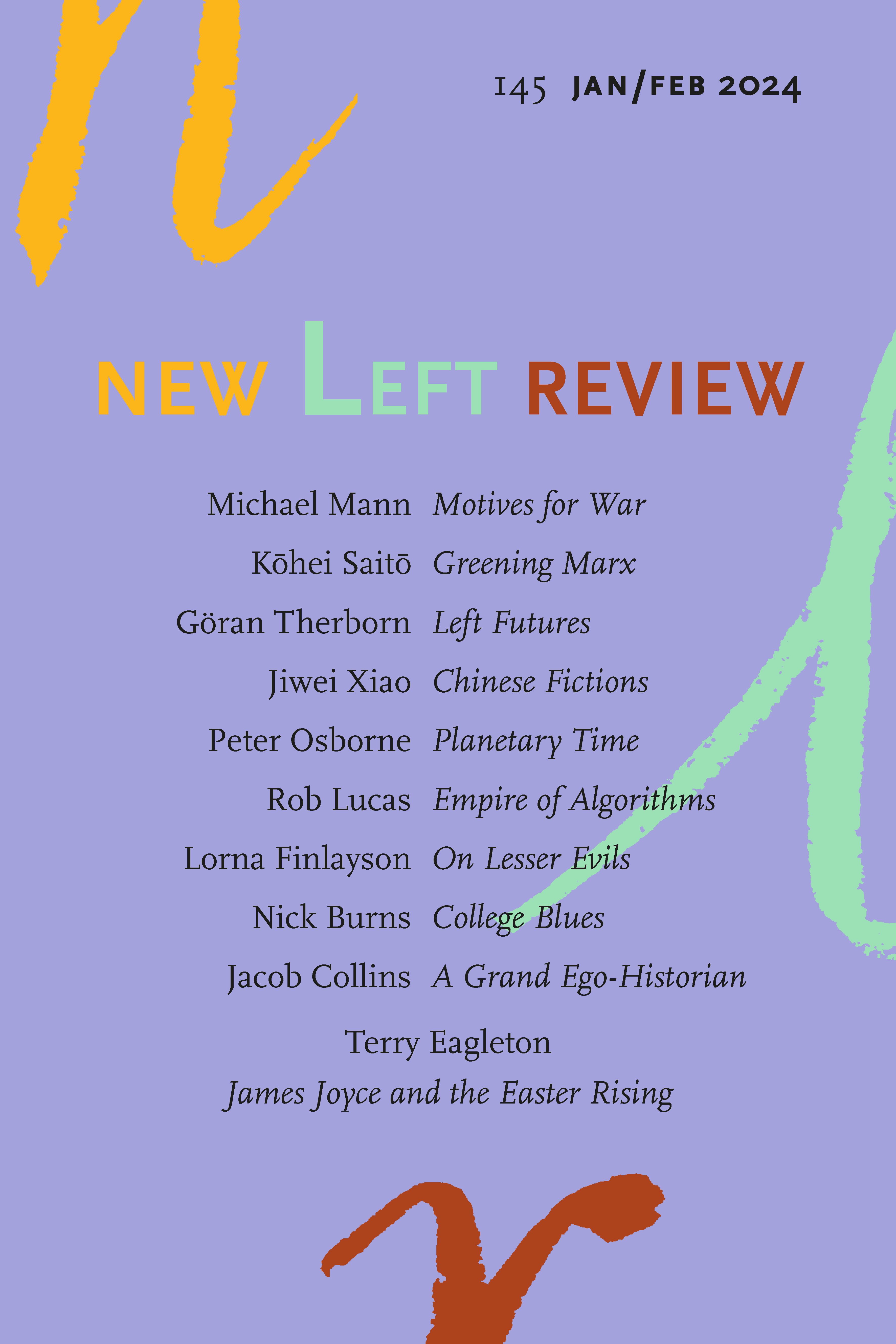
Drawing on eight years of comparative-historical research, Michael Mann overturns accepted wisdom on the bellicosity of democracies, the economic grounds for war and the rational calculations of states in a rivalrous world system.
NLR 145•
articles
Göran Therborn replies to Oliver Eagleton’s critique of ‘The World and the Left’ (NLR 137). Debates on the nature of dialectics and the triadic crisis of climate breakdown, imperial geopolitics and rising inequality. Could Bloch still be right about the grounds for rational hope?
The Japanese context of decades-long economic stagnation has helped to generate an unexpected reading of Marx as a proto-degrowth proponent. Kōhei Saitō discusses his novel synthesis of Kuruma School historical materialism, German philology and American eco-socialism.
The standard argument for backing hawkish centre-left parties remains the ‘lesser evil’. Lorna Finlayson interrogates that line of reasoning and the assumptions on which it rests: crude consequentialism, narrow minded electoralism and covering up the realities of Starmer’s Labour.
The intense debate around American student loans has largely been cast in moral terms—fairness, forgiveness, desert. Nick Burns instead provides a hard-headed analysis of the political and economic interests that built a credit pyramid out of higher education.
Jiwei Xiao traces the literary modes of the xijie xiaoshuo as it has registered successive periods of social and cultural change. From its emergence in the twilight of the Ming dynasty through to contemporary panoramas of urban and rural life, lineages of a multiform poetics of detail.
An incisive critique of the absence of the social and historical in Bruno Latour’s planetary politics and Dipesh Chakrabarty’s geo-biology. The political, Osborne argues, is a modality of the social, which is already a socio-natural set of relations.
reviews
Rob Lucas on Lorraine Daston, Rules. A historian of science tackles the thinning of ‘rules’: how paradigms to play with became regulations and algorithms to obey.
Jacob Collins on Pierre Nora, Jeunesse and Une étrange obstination. Recollections of French intellectual life from the theorist of self-historicization.
Terry Eagleton on Luke Gibbons, James Joyce and the Irish Revolution. Rereading of Ulysses as a saturnine blow for the Irish independence struggle.